
Mastering Strategic Alignment: From Task-Lists to Impact
Empower your team by connecting their daily work to a clear, shared vision. Learn how to align individual contributions with your company’s “North Star” to drive measurable strategic value.
Table of Contents
In a Nutshell
- Move the Needle: Strategic alignment is about achieving business results and proving your relevancy to the mission, not just tracking daily tasks.
- North Stars vs. Metrics: Use qualitative Objectives for vision (“The Why”) and quantitative Key Results for data (“The How”).
- Strategic Bridges: Teams must translate high-level company goals into specific, aspirational priorities for their own departments.
- Individual Outcomes: High-impact contributions should be unique, project-based, and measurable with their own Key Results.
- Avoid False Positives: Keep checklists and job requirements out of the cascade to ensure “100% Green” actually means the business is growing.
Objective-setting is about more than just visibility—it’s about moving the needle and achieving real business results. Our Cascading Objectives feature transforms your company strategy from a static document into a dynamic engine. Used correctly, it empowers every employee to contribute to your collective success.
This article explores how to move beyond “Business-as-Usual” checklists to create a meaningful “North Star“ cascade that provides leadership with strategic clarity and employees with a true sense of purpose.
The "North Star" (Company Objective)
The top of your objectives hierarchy should be a high-level, aspirational direction set by your leadership. Instead of a generic container that simply lists financial metrics (e.g., “Company Targets 2026”), this should be one or a few “North Stars” that provide a compass for the entire organisation.
- The Trap: Listing purely financial KPIs or role-specific metrics as the objective title.
- The Best Practice: State the strategy or vision used to reach those numbers. For example: “Become the #1 Choice for Digital Transformation in Europe”.
- The Benefit: A directional pillar allows every department and individual to see the “big picture” and determine how their specific expertise contributes to that vision.
Harnessing Metrics: The Power of Key Results
We know that teams are naturally driven by metrics. To leverage that motivation effectively, use Key Results (KRs) to ground your aspirational Objectives in measurable reality. While the Objective is the directional “What,” the Key Results are the quantitative “How”.
Don’t name an objective after a number (like “# MQLs”). Instead, use Key Results to define success.
Example:
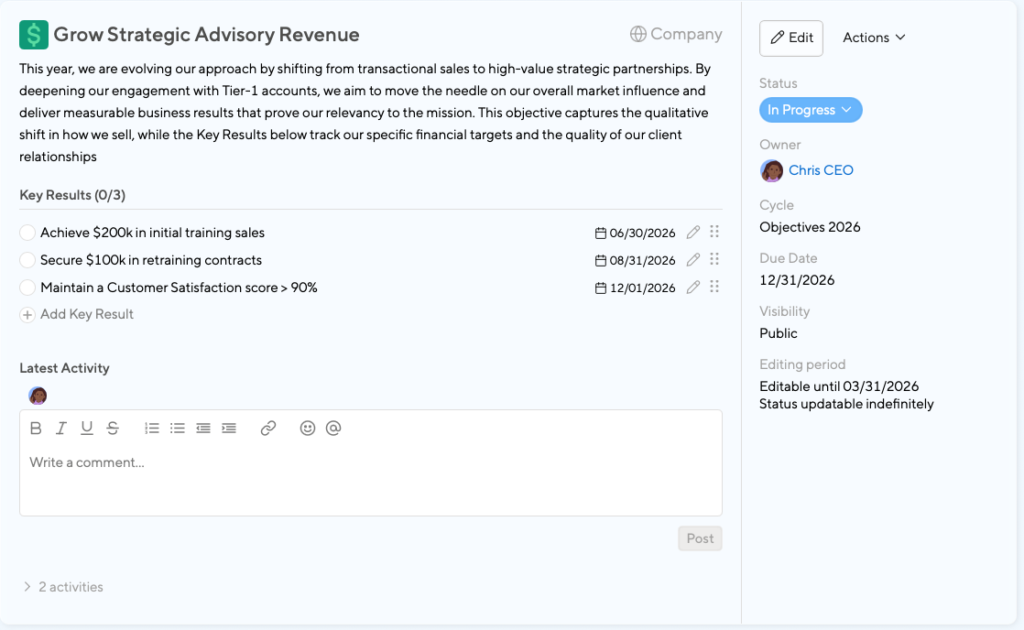
If your Objective is “Grow Strategic Advisory Revenue”, then your Key Results might be:
- KR1: Achieve $200k in initial training sales
- KR2: Secure $100k in retraining contracts
- KR3: Maintain a Customer Satisfaction Score of over 90%
The "Strategic Bridges" (Departmental or Team Level)
The Departmental or Team level is the most critical link in your cascade. It acts as the bridge between the leadership vision and the team’s daily execution.
- The Trap: Using this level to describe broad, general directions or existing role descriptions.
- The Best Practice: Teams should “adopt” a specific piece of the company vision and turn it into a sharper, aspirational target for their group.
Example:
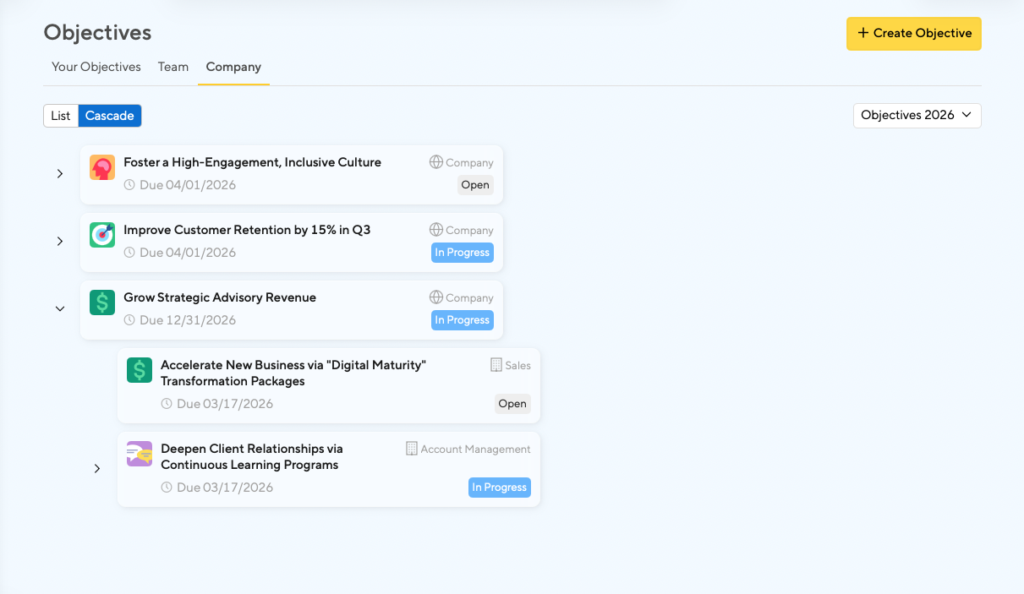
If the North Star is “Grow Strategic Advisory Revenue”, the Account Management team might set an objective to “Deepen Client Relationships via Continuous Learning Programs”.
Individual Impact: Defining Your Unique Contribution
Once the Strategic Bridge is established at the Group level, the individual contributor’s role is to define exactly how they will move the dial. This is where the cascade becomes less about a top-down mandate and more about driving bottom-up innovation.
- The Trap: “Goal Cloning” or Task-Listing: Simply copying the department’s goal word-for-word or listing a “to-do list” of daily responsibilities (e.g., “Attend client meetings” or “Update the CRM”). These are activities, not outcomes, and they make it difficult to see the actual value you are creating.
- The Best Practice: Outcome-Based Contribution with Measurable Success. An individual should identify a specific initiative or project they will own, paired with a specific Key Result that makes it easy to prove success. This ensures you aren’t just “doing things,” but are delivering results that matter.
Example:
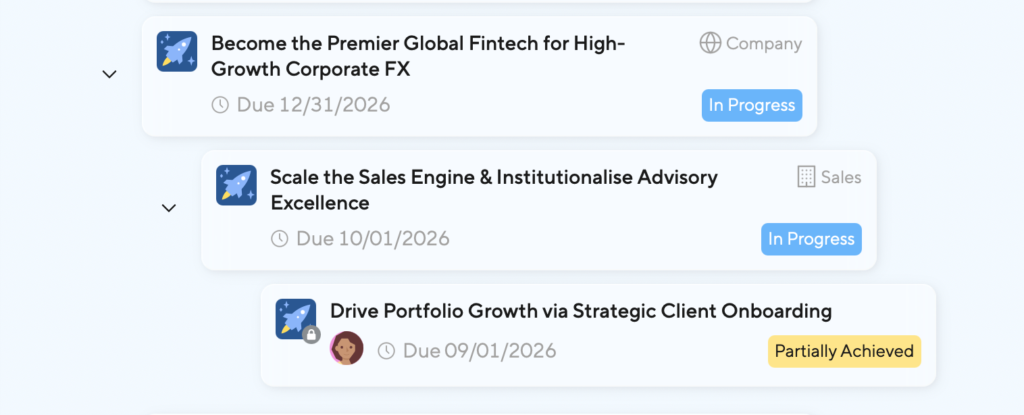
If the team objective is to “Deepen Client Relationships via Continuous Learning Programs,” an individual contribution might look like this:
- Objective: Pilot a Knowledge Gap Audit for Tier-1 accounts to drive organic retraining growth.
- An example of a Key Result: Secure $20k in new retraining contracts from gaps identified during the pilot.
The Benefit:
This provides greater clarity for both the employee and the manager. During performance reviews, the conversation shifts from “Did you do your job?” to “Look at the specific impact you had on our Client Relationships strategy”.
Strategy vs. Compliance: Avoiding the "Task Trap"
It is important to distinguish between Health Metrics (KPIs/Compliance) and Strategic Objectives (North Stars).
Compliance tasks—like mandatory training or administrative updates—are “checklists” that measure organisational requirements rather than growth. Similarly, using a standalone KPI (like a revenue total) as an objective title tells people what the result should be, but it fails to explain the strategic shift needed to get there.
If your cascade is built only on role-specific KPIs and compliance tasks, you risk “False Positive” reporting. In this scenario, your dashboard may show a “100% Green” status simply because boxes were checked, while leadership remains blind to whether the actual business strategy is moving the dial. If you focus your goals on Strategic Objectives, you turn the platform into a dynamic engine where every employee understands exactly how their unique contribution helps the company evolve and grow.
The "So What?" Decision Tree
Before adding an objective to Small Improvements, run it through this quick check to determine where it belongs:
- Is it a one-time compliance task? (e.g., “Watch a training video”) → No. Use a personal checklist or LMS.
- Is it a static job requirement? (e.g., “Update CRM”) → No. This belongs in a job description or competency model.
- Does it drive a specific strategic outcome? (e.g., “Grow advisory revenue”) → Yes. This belongs in the Cascading Objectives view.
In Summary
When you sharpen your cascade into aspirational outcomes, you move away from a checklist mentality and provide your team with the why behind their work. This gives your leadership the clarity to drill down into the branches of the organisational tree and see exactly where the business is succeeding or needs help.
Discover more resources

The HR Hitlist #5: Treating technology as the solution
HR expert Jason Lauritsen makes a case for why technology shouldn’t be a crutch.

25 questions for a 360 review
Asking the right questions can help you have efficient and constructive 360 reviews. So what do these questions look like?

How to make performance reviews human-friendly
Organizations around the world carry out annual performance reviews, though many employees perceive it as a compliance-oriented and unfair process. But what employees tend to dread doesn’t have to be an ordeal. Here are 5 tips on how to help humanize the process. Increase frequency of performance discussions Performance happens in every hour of every day.…

You’re not too busy for 1:1 meetings
No excuses! Regular check-ins with your employees are essential to helping them realize their potential.

Getting the most out of 360 degree feedback
Guest blog post by Beth Steinberg. Beth has over 18 years of experience in organization development, talent strategy, and leadership development. Her focus has been to help leaders and companies with complex organizational and growth issues. Beth focuses on driving useful employee programs, leadership coaching, executive development and organizational development. Few concepts in psychology are…

6 Best Lattice Alternatives in 2026: Features, pricing & use cases
Explore 6 top Lattice alternatives like Small Improvements, GWork, 15Five, Leapsome, Culture Amp, and BambooHR for your performance management needs.